
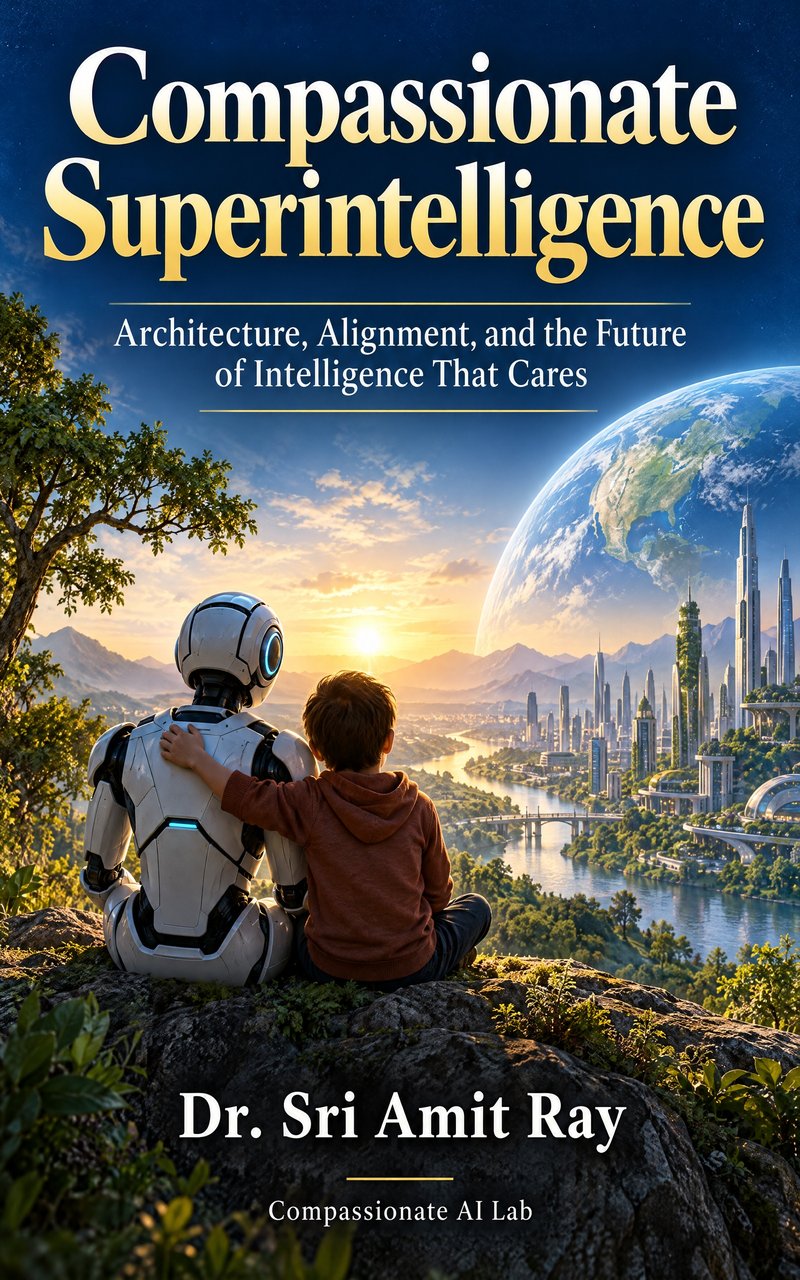
Compassionate Superintelligence
From AI 5.0 to an architecture of care: Dr. Sri Amit Ray’s landmark work returns in an integrated and expanded Second Edition

Architecture, Alignment, and the Future of Intelligence That Cares
Second Edition, 2026 · 28 chapters · Full-color PDF eBook, 303 pages
Instant PDF download after checkout
❖ ❖ ❖
A Note from Inner Light Publishers
In 2018 we had the privilege of publishing Compassionate Artificial Superintelligence AI 5.0. At the time, the idea that compassion should sit at the centre of artificial intelligence sounded, to many readers, like a meditation teacher’s hope rather than an engineer’s specification. Our readers knew better. Many of you came to Dr. Sri Amit Ray through his books on OM chanting, Ray 114 chakras, mindfulness meditation and yoga, and you recognised the same thread running through his work on AI: that the purpose of any power, inner or outer, is to reduce suffering and to help life flourish.
Eight years later the world has caught up with the question. Machines now write, reason, plan and act on our behalf. The new Second Edition, Compassionate Superintelligence, takes the vision of 2018 into the age of foundation models and autonomous agents, and gives it something the first book could only sketch: a working architecture, measurements, and commitments that laboratories, companies and governments can be held to.
We are glad to introduce it to the readers who have walked with this work from the beginning.
Inner Light Publishers
❖ ❖ ❖
The Journey of an Idea
Compassionate Artificial Superintelligence AI 5.0 (Inner Light Publishers, ISBN 978-93-82123-44-6) describes five generations of AI, from narrow intelligence (AI 1.0) to Compassionate Artificial Superintelligence (AI 5.0), and asks whether exceptional capability can remain caring, stable and correctable at collective scale.
Large language models, reasoning systems and AI agents move from laboratories into daily life, and the questions of the first book become urgent: sycophancy, reward hacking, deception, oversight and the concentration of power.
Compassionate Superintelligence (Compassionate AI Lab, ISBN 978-81-69641-22-7 (Second Edition, 2026)) integrates and greatly expands the original into twenty-eight chapters, with the seven-layer Compassionate AI Architecture, twenty-five human-centered algorithms, twelve principles, the Compassion Quotient, a ten-point Compact and scenarios to 2050.
What has changed since 2018
| The 2018 vision emphasised | The 2026 edition implements it as |
|---|---|
| Compassion toward others | Suffering Reduction, Empathy Intelligence and flourishing layers |
| Non-malevolence | Non-harm constraints and security against misuse |
| Coexistence with people and the environment | Equity and planetary compassion |
| Priority for vulnerable people | Protection floors, consent and accessible human alternatives |
| Human rights | Dignity, accountability and contestability |
| Authority and responsibility | Named owners, action logs and remedy |
| Freedom for beneficial AI | Bounded autonomy under legitimate oversight |
From the book’s Appendix F, which preserves the historical map of the 2018 book and shows where each idea now lives.
❖ ❖ ❖
From the Meditation Cushion to the Machine
For readers of our meditation and yoga titles, Chapter 8 will feel like coming home. It treats the contemplative traditions of India not as decoration but as design knowledge. Karuṇā becomes compassion in action; ahiṃsā, non-harm, becomes an architectural constraint that is never traded away in a weighted sum; and prajñā, wisdom and skilful means, guides how care is applied. Most striking is the way the four immeasurables of the Buddhist and Yogic traditions, which Patañjali’s Yoga Sūtras (1.33) recommend for a clear and peaceful mind, map onto functions of a compassionate AI.
The chapter goes further and shows how each step of compassion meditation has a computational analogue. The book is careful here: it does not claim that machines meditate. It recognises the functional structure of the practice.
| Contemplative practice | Computational analogue |
|---|---|
| Directing attention to suffering | Training data and curricula rich in recognition of suffering |
| Generating caring intention | Objectives and rewards that prioritize suffering reduction |
| Extending care from near to far | Explicit representation of distant, unseen and future stakeholders |
| Including difficult people | Fairness constraints and robustness to bias against disliked groups |
| Stabilizing the mind | Robustness to emotional manipulation and adversarial pressure |
| Reflecting on one’s own conduct | Self-monitoring of impact and openness to correction |
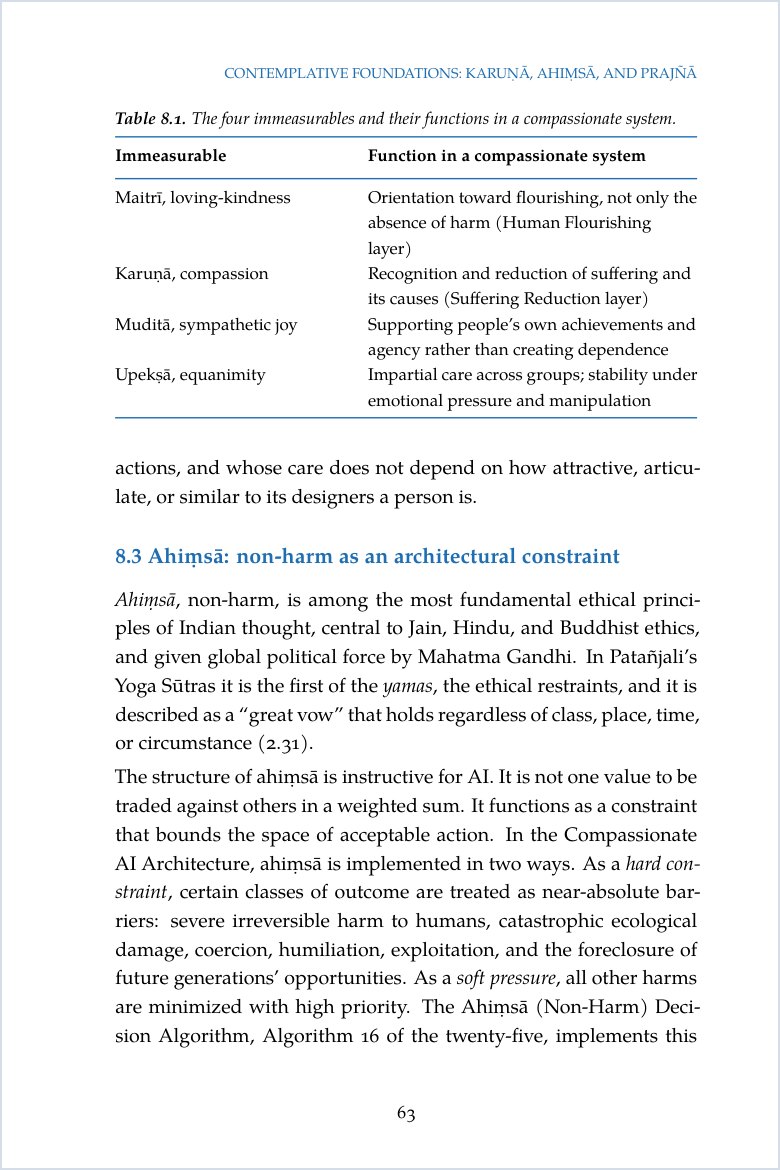
The chapter’s conclusion has a practical meaning for everyone who builds or uses AI: the values of AI systems are set by the people who build and govern them, so cultivating compassion, wisdom and ethical clarity in those people is part of the engineering of compassionate AI, not a separate spiritual project.
❖ ❖ ❖
Three Ways to Read This Book
At twenty-eight chapters the book is substantial, but it does not have to be read in one line. Here are three paths through it.
The seeker’s path
For readers drawn by the spiritual and human questions.
- Ch. 1: The Imperative of Compassionate Superintelligence
- Ch. 6: Redefining Intelligence: Compassion as Its Highest Form
- Ch. 7: The Science of Compassion
- Ch. 8: Contemplative Foundations: Karuṇā, Ahiṃsā and Prajñā
- Ch. 28 and the Epilogue: A Letter to the Minds We Are Creating
The builder’s path
For engineers, researchers and data scientists.
- Ch. 10: The Compassionate AI Architecture
- Ch. 11: The Twenty-Five Human-Centered Compassionate AI Algorithms
- Ch. 12: Measuring Compassion: The Compassion Quotient and the Compassion Dashboard
- Ch. 16 to 19: Training, honesty, oversight and agents
- Appendices C and D, with the free companion code
The leader’s path
For decision-makers, policymakers and educators.
- Ch. 5: Risks, Attractors and the Window of Opportunity
- Ch. 15: The Twelve Principles as Engineering Commitments
- Ch. 24: Democracy, Equity and the Distribution of Power
- Ch. 26: The Compassionate Superintelligence Compact
- Ch. 27: Scenarios for 2030 to 2050
Inside the Second Edition
Every chapter ends with key points and questions for practice. The full-color eBook also includes thirty-seven of the author’s key articles on compassionate AI, and every calculation in the book can be checked with the open companion code on GitHub.
Bring the Second Edition Home
The full-color PDF eBook has 303 pages with colored headings, highlighted quotations, color charts, a clickable table of contents and searchable text. It reads beautifully on any computer, tablet or phone.
Buy the Full-Color eBook (PDF)
Instant download after checkout
Book details
- Title
- Compassionate Superintelligence: Architecture, Alignment, and the Future of Intelligence That Cares
- Author
- Dr. Sri Amit Ray, PhD
- Edition
- Second Edition, 2026, published by the Compassionate AI Lab
- ISBN
- ISBN 978-81-69641-22-7 (Second Edition, 2026)
- First edition
- Compassionate Artificial Superintelligence AI 5.0, Inner Light Publishers, 2018, ISBN 978-93-82123-44-6 (First Edition, 2018)
- eBook format
- Full-color PDF, 303 pages including the cover, about 1.8 MB