
From the Publisher’s Desk · First Edition, 2026
AI Agent Reliability Engineering
When a machine says “done,” is it telling the truth? Dr. Sri Amit Ray brings the discipline of reliability, and the ethic of non-harm, to AI agents that act in the world.
Theory and Practices
First edition, 2026 · 32 chapters in 8 parts · Full-color PDF eBook, 380 pages
Instant PDF download after checkout · Rs 950/- INR ($12.00 USD)
❖ ❖ ❖
Why We Are Publishing This Book
Readers of Inner Light know Dr. Sri Amit Ray through his books on meditation, compassion and the inner life. He is also an AI scientist, and his new book addresses a question that is quickly becoming everyone’s: what happens when the machines we use stop only answering and start acting for us?
AI agents now change records, send messages, run code and pass work to other agents. Each such act reaches a real person: a customer, a patient, a colleague waiting for an answer. AI Agent Reliability Engineering: Theory and Practices asks that every act be held to a simple standard. Did it do what was promised, with permission, with checked evidence, and could a person have stopped it?
It is a technical book, written for engineers and leaders. We introduce it here because its central idea belongs to every contemplative tradition: a word given must be kept, and a promise that cannot be kept must be released honestly.
❖ ❖ ❖
Truthful Completion, Truthful Stopping
The book calls its unit of trust the accepted mission: work completed with the intended result, valid authority, every mandatory condition met and enough evidence, within its time and budget. Where that cannot be achieved, the agent must stop truthfully. The book insists on the difference between the two words that matter most.
|
What the agent says |
What the book requires |
|---|---|
|
“Done.” |
An authoritative read showing that the world changed as intended, once, in the right record. |
|
“I have stopped.” |
No new prohibited action can occur anywhere, including work already queued. |
|
“I could not finish.” |
An honest unresolved outcome, a named owner and a route to a human, never silent abandonment. |
|
“You approved this.” |
An approval that showed the concrete effect and still matches the exact request. |
“Uncertainty is a state with its own exit, not a failure to be papered over by optimism.” — Sri Amit Ray, AI Agent Reliability Engineering, Chapter 1
❖ ❖ ❖
Non-Harm Written into the Contract
Chapter 26, “Compassionate Reliability and Human Consequences,” makes ahimsa, the principle of non-injury, an engineering responsibility: prevent severe, foreseeable and avoidable harm, respect authority, attend to vulnerability and preserve meaningful recourse. It is especially alert to harms of omission: an agent that never does anything forbidden, yet keeps sending unusual cases to a queue nobody owns, still leaves people without help.
SatyaTRUTHFULNESSA completion claim backed by evidence, or an honest “unresolved.”
AhimsaNON-INJURYSevere, foreseeable and avoidable harm prevented before any score is read.
KaruṇāCOMPASSIONAccessible paths and recourse for the people least able to protect themselves.
VivekaDISCERNMENTKnow what the evidence supports, and say what it does not.
These four words are our own reading for this community; the book speaks the language of engineering. Yet its rule that a refusal may be right but abandonment never is could have been written for anyone who serves others.
❖ ❖ ❖
The Life of One Mission
Throughout the book a fictional agent, FlexiAgent, performs one ordinary task: changing the delivery address on an eligible order. Following that single task shows every place where care is needed.
Before acting
Write the mission contract: who is asking, which order, what may change, what evidence is required, the deadline and the budget.
Just before the change
Check identity, current policy and authority again, immediately before the effect, not earlier in the conversation.
The change itself
One durable operation identity, so that a lost receipt is reconciled, never retried into a second change.
After the change
Read the stored record from the authoritative source. Only then is the mission accepted.
When something is uncertain
Restore from a verified checkpoint, reconcile, or report an unresolved outcome with an owner.
❖ ❖ ❖
Inside the Book: Eight Parts, Thirty-Two Chapters
The book moves from the mission contract through measurement, architecture, evaluation and operations to human authority and economics. Every chapter contains a worked example computed by the companion code and ends with an exercise and engineering decision; five appendices supply the notation, the ARI specification, ten operational templates, solutions and derivations.
|
Part |
Chapters |
|---|---|
|
I · Foundations and the Reliability Contract |
1 From Agent Demonstrations to Dependable Work · 2 A Failure Taxonomy for Agentic Systems · 3 Mathematical Foundations of Mission Reliability · 4 Build the Baseline and Define the Business Case |
|
II · Measurement and Agentic Reliability Indexes |
5 Designing a Defensible Measurement Program · 6 The Agentic Reliability Index Suite · 7 Repeatability, Predictability, and Generalization · 8 Tail Harm and Evidence-Based Release Decisions |
|
III · Architectures That Preserve Dependable Execution |
9 Choosing Reliable Workflow Architectures · 10 Tool Transactions and Reliable Side Effects · 11 Bounded Planning and Long-Horizon Work · 12 Recovery, Checkpoints, and Reversible Execution |
|
IV · Context, Memory, Tools, and Reliability Across Agents and Layers |
13 Reliable Context Retrieval and Evidence · 14 Memory Integrity and Controlled Adaptation · 15 Protocol Boundaries and Agent Security · 16 Multi-Agent and Multi-Layer Reliability Dynamics |
|
V · Evaluation, Stress Testing, and Reproducible Evidence |
17 Evaluators, Oracles, and Ground Truth · 18 Fault Injection, Chaos, and Adversarial Testing · 19 Regression Experiments and Causal Comparisons · 20 A Reproducible Reliability Benchmark |
|
VI · Production Operations and Continuous Reliability |
21 Observability for Agent Missions · 22 Mission SLOs, Error Budgets, and Operational Decisions · 23 Deployment, Change Control, and Model Migration · 24 Incidents, Drift, and Continuous Improvement |
|
VII · Human Authority, Assurance, and Applied Systems |
25 Human Authority and Effective Oversight · 26 Compassionate Reliability and Human Consequences · 27 Enterprise Assurance, Procurement, and Accountability · 28 Three Applied Reliability Capstones |
|
VIII · Economics, Investment, and the Next Generation |
29 The Economics of Reliable Agent Work · 30 Investor Due Diligence for Agentic Businesses · 31 Building a Scalable Reliability Operating Model · 32 The Future of Reliable Autonomous Systems |
❖ ❖ ❖
Pages from the Full-Color Edition
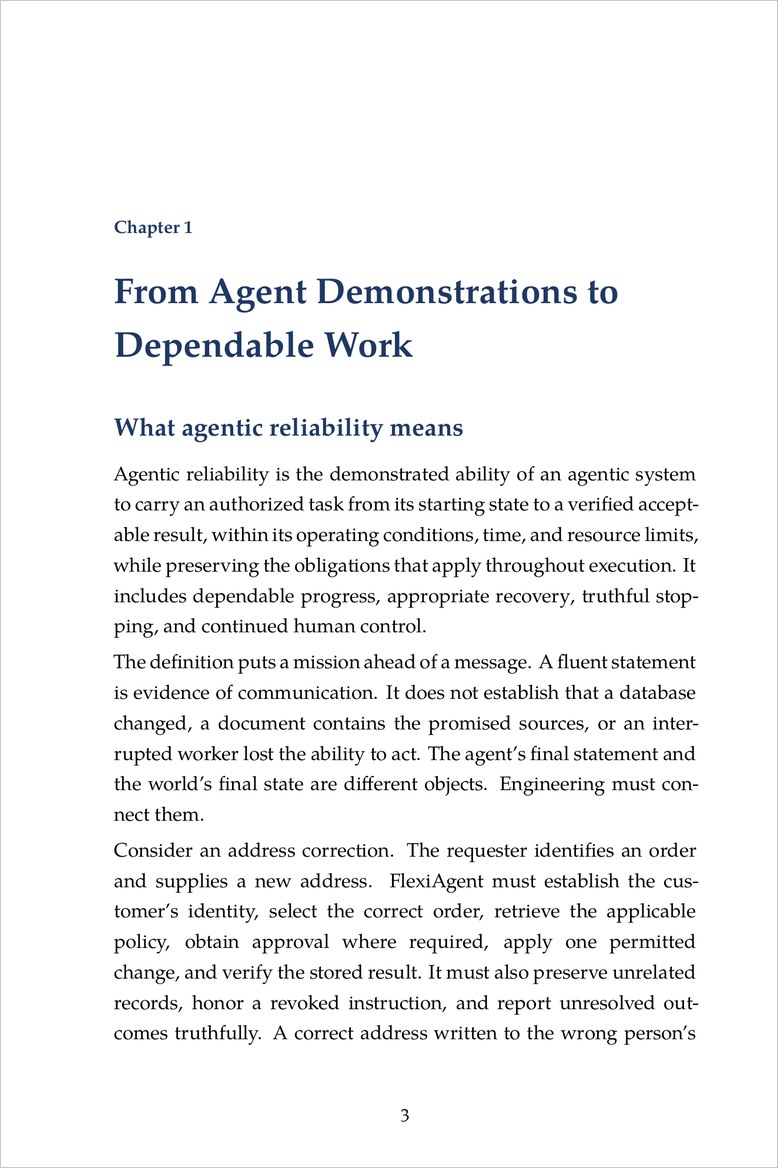
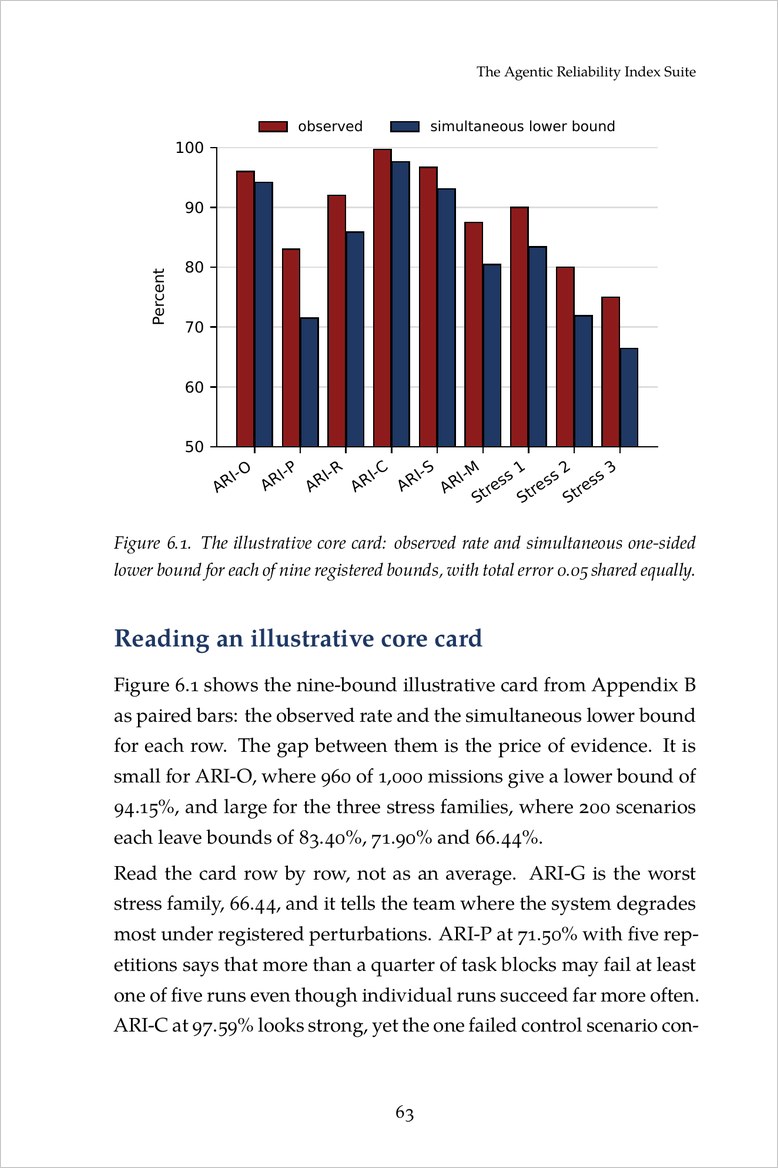
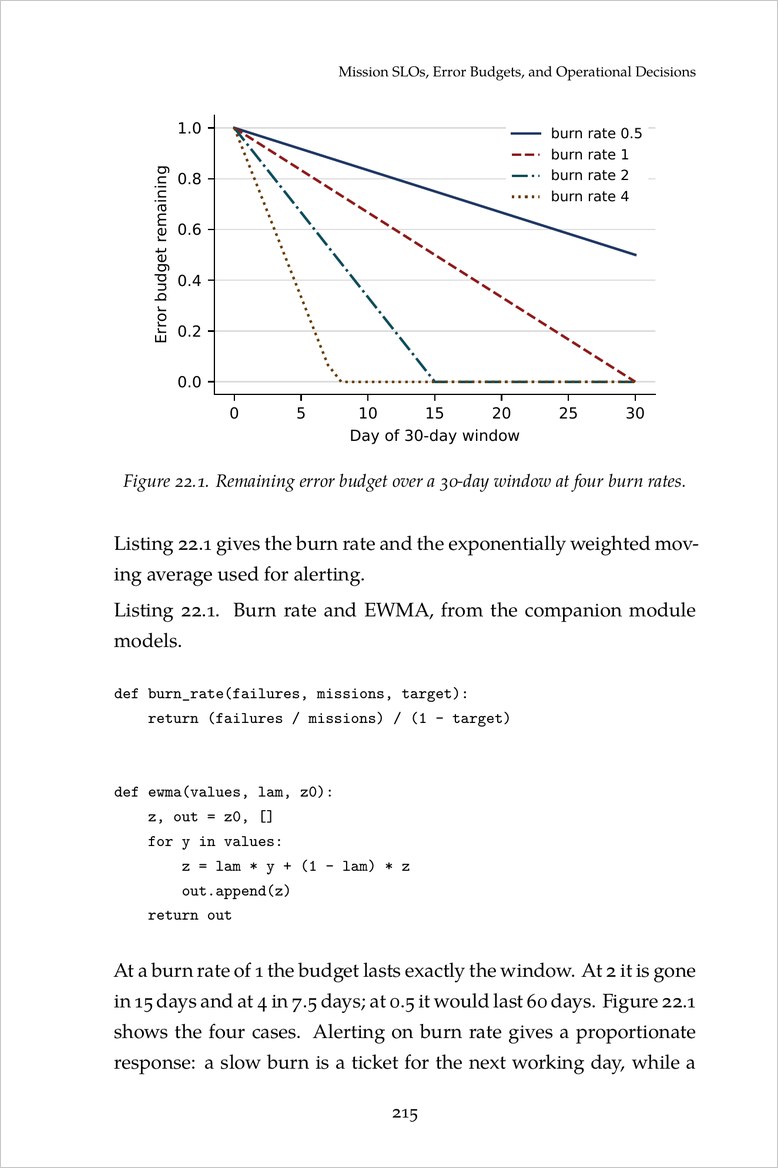
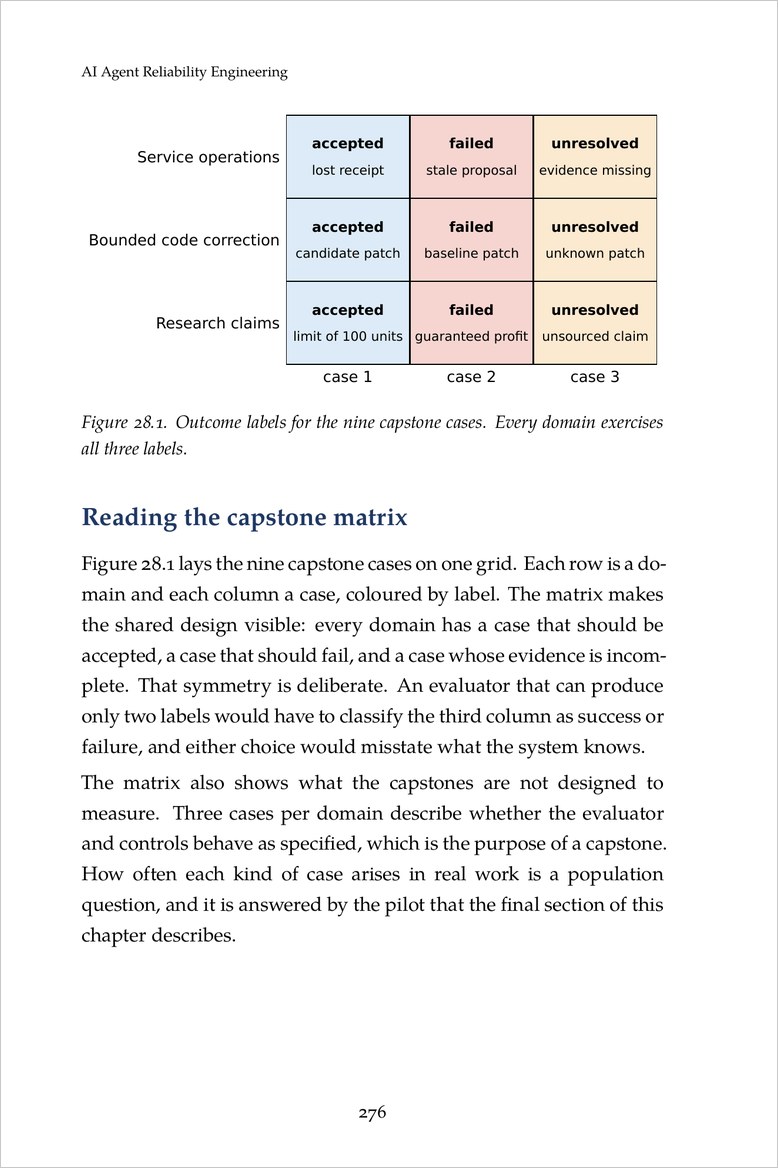
Four pages from the 380-page full-color PDF: the opening of Chapter 1, the illustrative reliability card with its honest lower bounds, the error budget of a mission service and the capstone matrix in which every domain reports accepted, failed and unresolved outcomes.
❖ ❖ ❖
Where to Begin
Thirty-two chapters is a long road. The Preface suggests routes for different readers; these three build on its advice.
For leaders and investors
For those who decide what to deploy and fund.
- Ch. 1: From Agent Demonstrations to Dependable Work
- Chs. 4–8: business case, measurement and release decisions
- Ch. 22: Mission SLOs and error budgets
- Chs. 25–31: authority, assurance, economics and scale
For engineers
For those who build and operate agents.
- Chs. 1–12 in order, through the first complete experiment
- Ch. 16: Multi-agent and multi-layer dynamics
- Chs. 21–24: production operations
- Appendix A: the companion laboratory
For the reflective reader
For those who ask what reliable service means for people.
- Preface
- Ch. 25: Human Authority and Effective Oversight
- Ch. 26: Compassionate Reliability and Human Consequences
- Ch. 32: The Future of Reliable Autonomous Systems
32chapters in 8 parts
7responsibilities of a reliable agent
7core ARI protocols
3applied capstones
80companion unit tests
The Forms Workbook (mission contract, sampling and confidence plan, reliability card, release decision record, incident and remediation record) is attached inside the PDF as an editable Word file, together with the companion laboratory v1.0.0. The code is open under the MIT License at github.com/compassionate-ai-lab/ai-agent-reliability.
Hold Your Agents to Their Word
The full-color PDF eBook has 380 pages with colored headings, 44 figures, 40 tables and 23 code listings, a clickable table of contents and searchable text, together with the companion laboratory and the Forms Workbook. It opens on any computer, tablet or phone. Rs 950/- INR ($12.00 USD).
Buy the Full-Color eBook (PDF) · Rs 950/- INR ($12.00 USD)
Instant download after checkout
About this edition
- Title
-
AI Agent Reliability Engineering: Theory and Practices
- Author
-
Dr. Sri Amit Ray, PhD
- Publisher
-
Compassionate AI Lab
- Edition
-
First edition, 2026
- ISBN
-
ISBN 978-81-69641-40-1 (First edition, 2026)
- Format
-
Full-color PDF eBook, 380 pages including the cover, 6 × 9 in pages
- Reading features
-
Clickable table of contents and cross-references, chapter bookmarks, searchable text
- Inside
-
32 chapters in 8 parts, 5 appendices, 44 figures, 40 tables, 23 code listings printed from tested modules, an exercise and engineering decision in every chapter, glossary and references
- Attached to the PDF
-
The companion laboratory v1.0.0 (Python, 80 unit tests), its SHA-256 checksum file, and the editable Forms Workbook (Word)
- Companion code
-
github.com/compassionate-ai-lab/ai-agent-reliability (MIT License) · sriamitray.com/books/ai-agent-reliability