

From the Publisher’s Desk · Revised Expanded Edition
Ethical AI Systems
Machines now act on our behalf. Dr. Sri Amit Ray asks the question at the heart of every contemplative tradition: how should a powerful capability be held?

Frameworks, Principles, and Advanced Practices for the Age of Autonomous Intelligence
Revised Expanded Edition, 2026 · 12 chapters in 4 parts · Full-color PDF eBook, 167 pages
Buy the Full-Color eBook · Rs 950/- INR ($12.00 USD)
Instant PDF download after checkout
❖ ❖ ❖
A Note from Inner Light Publishers
Readers of Inner Light know Dr. Sri Amit Ray through his books on meditation, OM chanting and the inner life. Many are surprised to learn that the same author is an AI scientist who has spent years asking how intelligent machines can be made to serve life rather than harm it. Ethical AI Systems is where those two disciplines meet.
The first edition appeared in 2022. In the years since, artificial intelligence has crossed a line. Systems that once only answered questions now book appointments, pay invoices, file claims and write and deploy code. As the Preface puts it, the question has changed from what the system said to what it did, who allowed it, and who answers for the result.
This revised expanded edition keeps the original heart of the book, the service pyramid and its chapters on care, roboethics, disaster and medicine, and adds what our moment needs: a measurable way to judge data and models, a ladder of autonomy for machines that act, and a programme of governance that an organisation can actually run. We are glad to introduce it to our readers.
❖ ❖ ❖
Ahimsa as a Discipline of Choosing and Repairing
The book’s author writes from two traditions at once: the engineering discipline of artificial intelligence and computational neuroscience, and the contemplative discipline of meditation, non-harm and compassion. He does not claim that one supplies what the other lacks; he says both ask the same question in different words. In Chapter 1, ahimsa becomes an order of decision that any reader can follow.
|
The step |
What it asks |
|---|---|
|
1 · Exclude harm |
Identify the actions that violate rights or create unacceptable harm, and set them aside, however great the projected benefit. |
|
2 · Weigh benefit |
Compare the benefits of the actions that remain, including the costs of delay and of refusal. |
|
3 · Own and repair |
Require a named owner and a path of repair for whatever remains uncertain. |
This order prevents a large promised benefit from buying permission for a severe, avoidable injury. It also asks for more than refusal. When a home-care agent cannot verify a pharmacy, it must neither send an unsafe order nor abandon the patient; it must keep the request, reach a clinician and tell the patient in a language they understand. Compassion, the book says, is expressed in what a system does when its preferred action becomes unavailable.
“Efficiency cannot compensate for a violation of human dignity.” — Sri Amit Ray, Ethical AI Systems, Chapter 5
❖ ❖ ❖
Care, Companionship and Freedom
Some of the most moving pages concern care. Chapter 9 considers a companion robot for people living with dementia: it may remind residents about medicine, watch for night-time falls and hold conversations, but it must disclose that it is a machine, keep its data local, show when it records, and never replace the scheduled human visit. The provider is asked to accept openly that some residents will form attachments, and to keep human contact as the first relationship.
AhimsaNON-HARMHarm limits come first and cannot be traded for efficiency.
KaruṇāCOMPASSIONStronger protection for those least able to protect themselves.
SatyaTRUTHFULNESSA system that says it is a machine and gives a real reason.
SvatantraFREEDOMThe freedom to pause, to leave and to challenge a decision.
These four words are our own reading for this community; the book speaks the language of engineering and governance. Yet its section on relational freedom could have been written for a meditation hall: a companion that holds a person’s attention while shrinking their human relationships has failed, and the aim of compassionate companionship is to widen a person’s world. Its epigraph reads: “Compassionate AI serves human relationships; it must never make dependence its measure of success.”
❖ ❖ ❖
From 2022 to the Revised Expanded Edition
What has changed between the two editions is the centre of gravity. The Preface describes three new layers built on the original framework, each developed in the Compassionate AI Lab and tested on worked cases.
2022 · First edition
Frameworks, principles and domain practices of ethical AI, built around the service pyramid: roboethics, care for patients and the elderly, social care, disaster management, peacekeeping, medical research, drug design and pandemic response.
2026 · The ten indexes
Ten ethical AI indexes for data training and model evaluation, from cage and traps to anonymisation and human oversight, with a scoring rubric.
2026 · The agentic layer
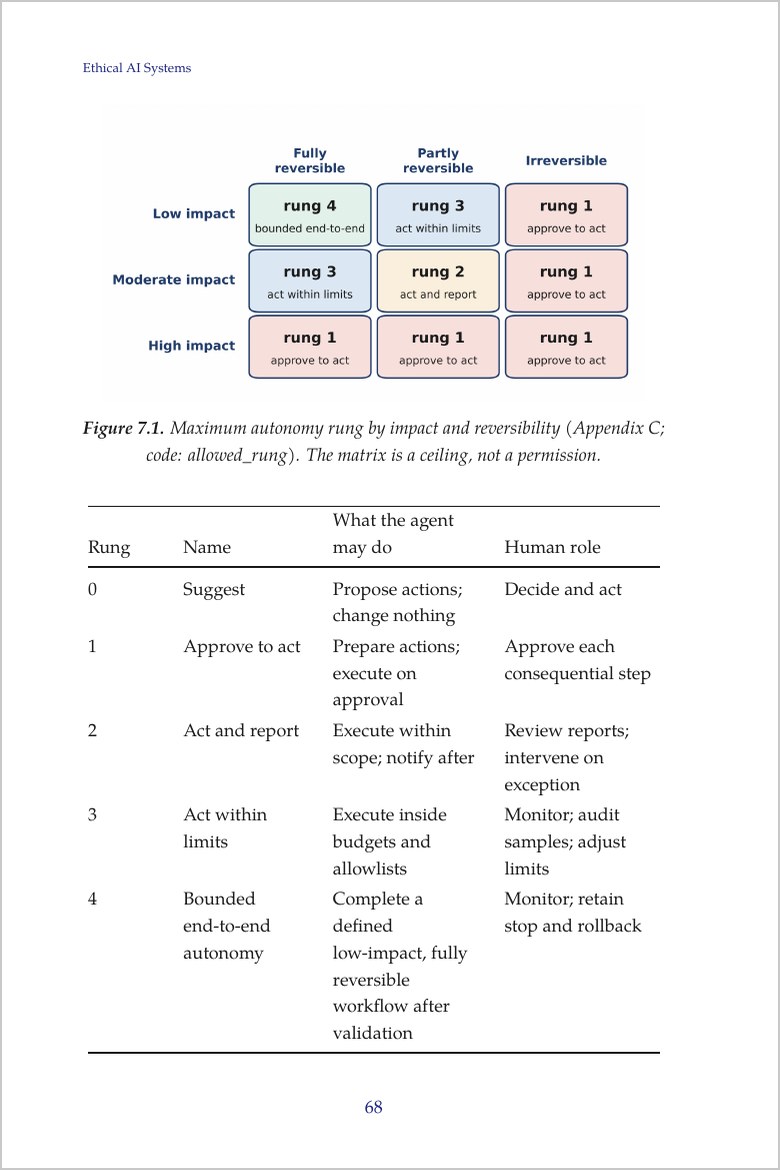
Accountability, consent and oversight when AI acts: a five-rung autonomy ladder, containment, red-teaming and incident response.
2026 · Governance
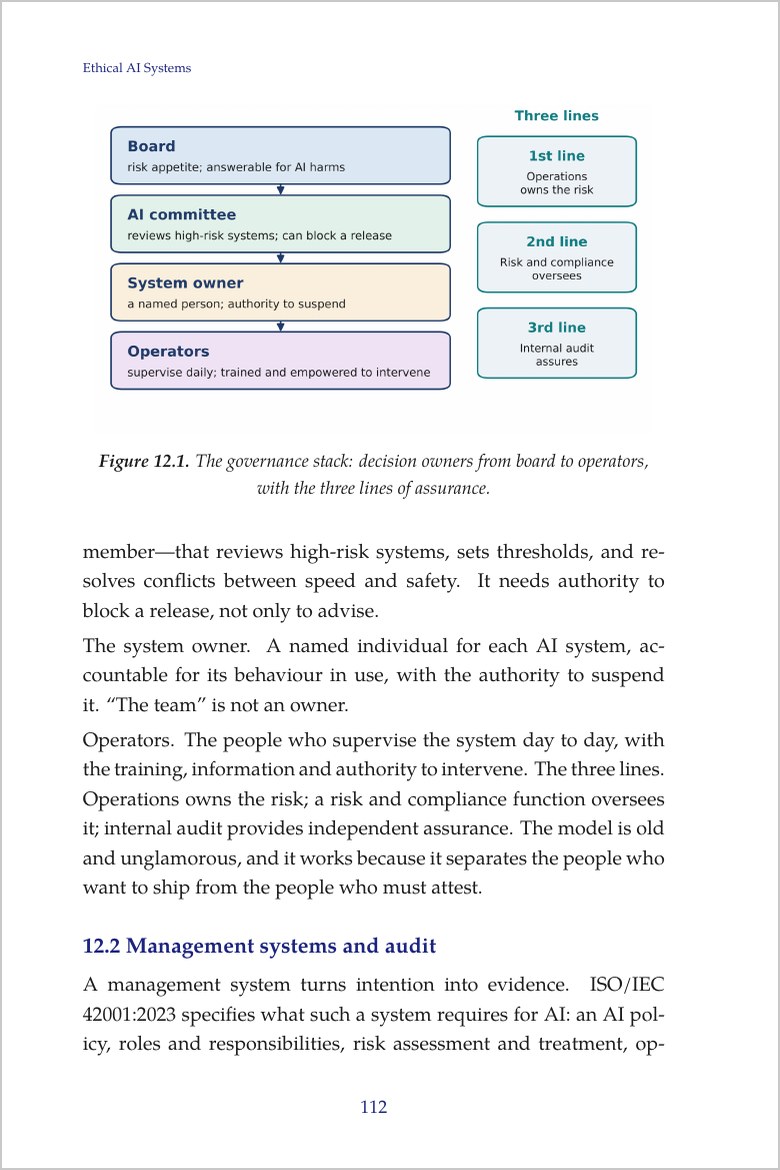
Board accountability, audit, procurement, liability and redress, twelve auditable commitments and a roadmap to 2030.
❖ ❖ ❖
Inside the Book: Four Parts, Twelve Chapters
The book moves from foundations to the institutions that must carry ethics into daily practice. Every chapter opens with an epigraph by the author, ends with key points and questions for practice, and is supported by appendices that turn its ideas into rubrics, checklists and protocols.
|
Part |
Chapters |
|---|---|
|
I · Foundations |
1 The Ethical Mandate · 2 Frameworks and Instruments · 3 The Service Pyramid |
|
II · Data and Models |
4 Data Ethics · 5 Bias, Fairness and the Ten Ethical AI Indexes · 6 Transparency, Explainability and Traceability |
|
III · Systems that Act |
7 Agentic AI: Accountability, Consent and Oversight · 8 Safety, Security and Containment · 9 Human–Robot Interaction and Roboethics |
|
IV · Domains and Institutions |
10 Health, Science and Drug Design · 11 Ethics under Pressure: Military, Disaster and Public Services · 12 Governance, Measurement and the Road Ahead |
❖ ❖ ❖
See Inside: Pages from the Full-Color Edition
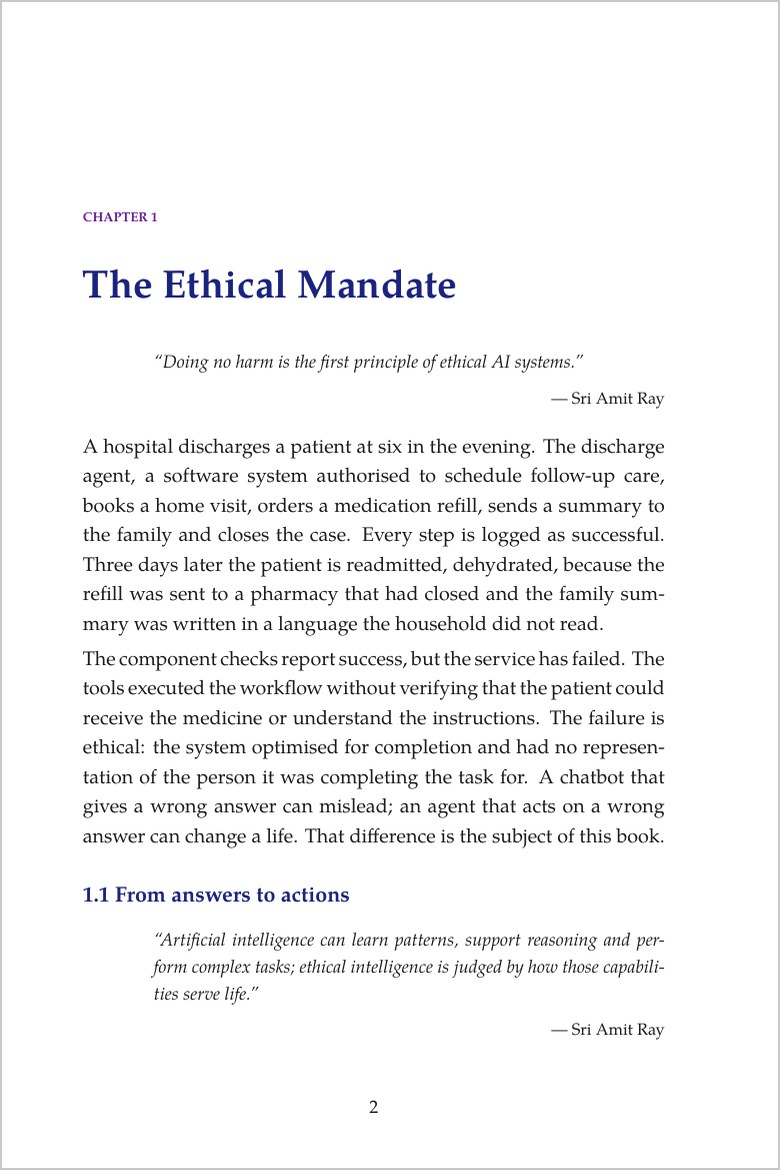
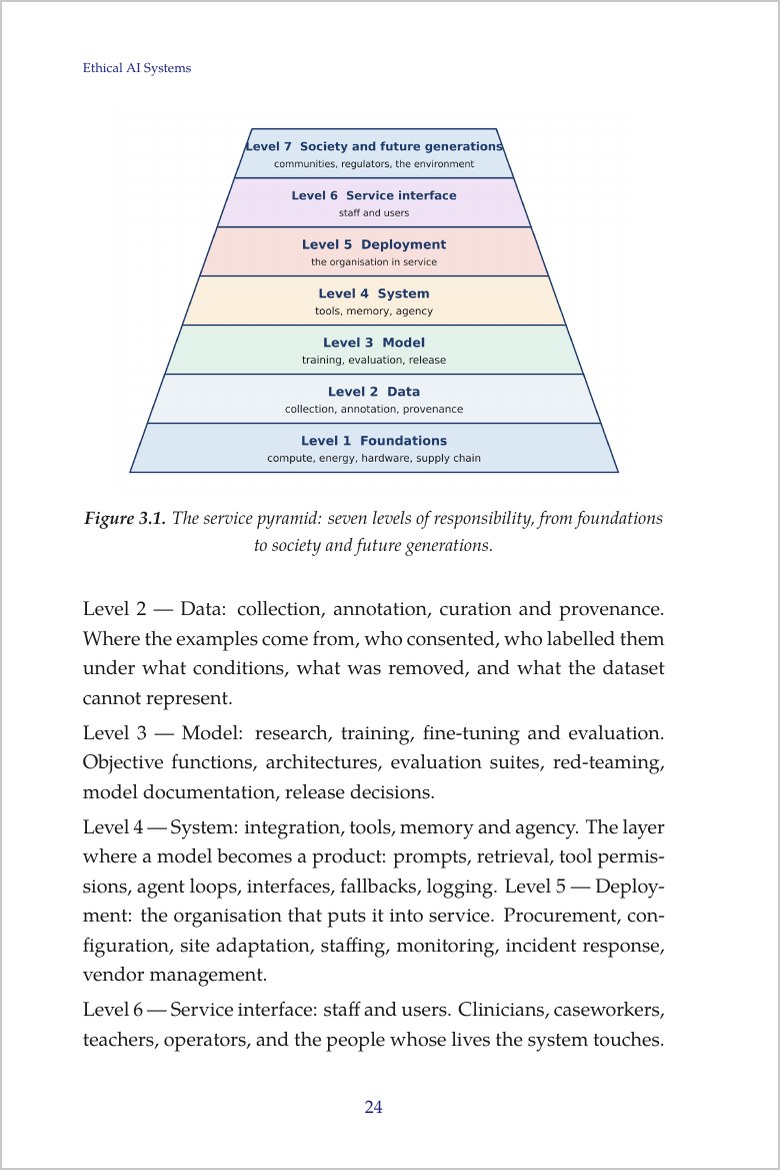
Four pages from the 167-page full-color PDF: the opening of Chapter 1 with its epigraph, the service pyramid of seven levels of responsibility, the autonomy ladder that matches a machine’s freedom to act with the impact and reversibility of its actions, and the governance stack that keeps decisions answerable from the board to the operator.
❖ ❖ ❖
Three Ways into the Book
Twelve chapters cover data, models, agents, robots and institutions. Readers of Inner Light may wish to begin with one of these three journeys and widen the circle from there.
For the reflective reader
For those who ask what intelligence is for.
- Preface
- Ch. 1: The Ethical Mandate
- Ch. 9: Human–Robot Interaction and Roboethics
- Ch. 12: Governance, Measurement and the Road Ahead
For those who care for others
For clinicians, carers, teachers and social workers.
- Ch. 3: The Service Pyramid
- Ch. 4: Data Ethics
- Ch. 10: Health, Science and Drug Design
- Ch. 11: Ethics under Pressure: Military, Disaster and Public Services
For those who build and lead
For engineers, product leaders and boards.
- Ch. 5: Bias, Fairness and the Ten Ethical AI Indexes
- Ch. 6: Transparency, Explainability and Traceability
- Ch. 7: Agentic AI: Accountability, Consent and Oversight
- Ch. 8: Safety, Security and Containment
12chapters in 4 parts
7levels of responsibility
10ethical AI indexes
5rungs of autonomy
12auditable commitments
The eleven worksheets of the Forms Workbook, attached inside the PDF in color and black-and-white printable versions and as an editable Word file, let a team, a hospital committee or a study circle work through the questions together. The open companion toolkit, written in plain Python with ten regression tests, reproduces every number in the book.
Begin Reading Today
The full-color PDF eBook has 167 pages with colored headings, nine color figures, boxed key points and thirty-four epigraphs, a clickable table of contents and searchable text, together with the Forms Workbook and the companion toolkit. It opens on any computer, tablet or phone.
Buy the Full-Color eBook (PDF) · Rs 950/- INR ($12.00 USD)
Instant download after checkout
Book details
- Title
-
Ethical AI Systems: Frameworks, Principles, and Advanced Practices for the Age of Autonomous Intelligence
- Author
-
Dr. Sri Amit Ray, PhD
- Publisher
-
Compassionate AI Lab · Compassionate AI Series
- Edition
-
Revised Expanded Edition, 2026 (first edition 2022)
- ISBN
-
ISBN 978-81-69641-39-5 (Revised Expanded Edition, 2026)
- First edition
-
ISBN 978-93-82123-54-5 (2022)
- Contents
-
12 chapters in 4 parts, 5 appendices, 9 color figures, 17 tables, 34 epigraphs, glossary and references
- eBook format
-
Full-color PDF, 167 pages including the cover, about 3 MB; clickable table of contents, bookmarks and searchable text
- Attached to the PDF
-
The Python companion toolkit and the Forms Workbook (color and black-and-white printable PDFs, editable Word file)
- Companion code
-
github.com/compassionate-ai-lab/ethical-ai-systems (MIT License)